Guess the Console
Ten legendary hit songs and the recording desks behind them — from Nirvana's Neve to a Mackie 8-Bus. Can you match them all?
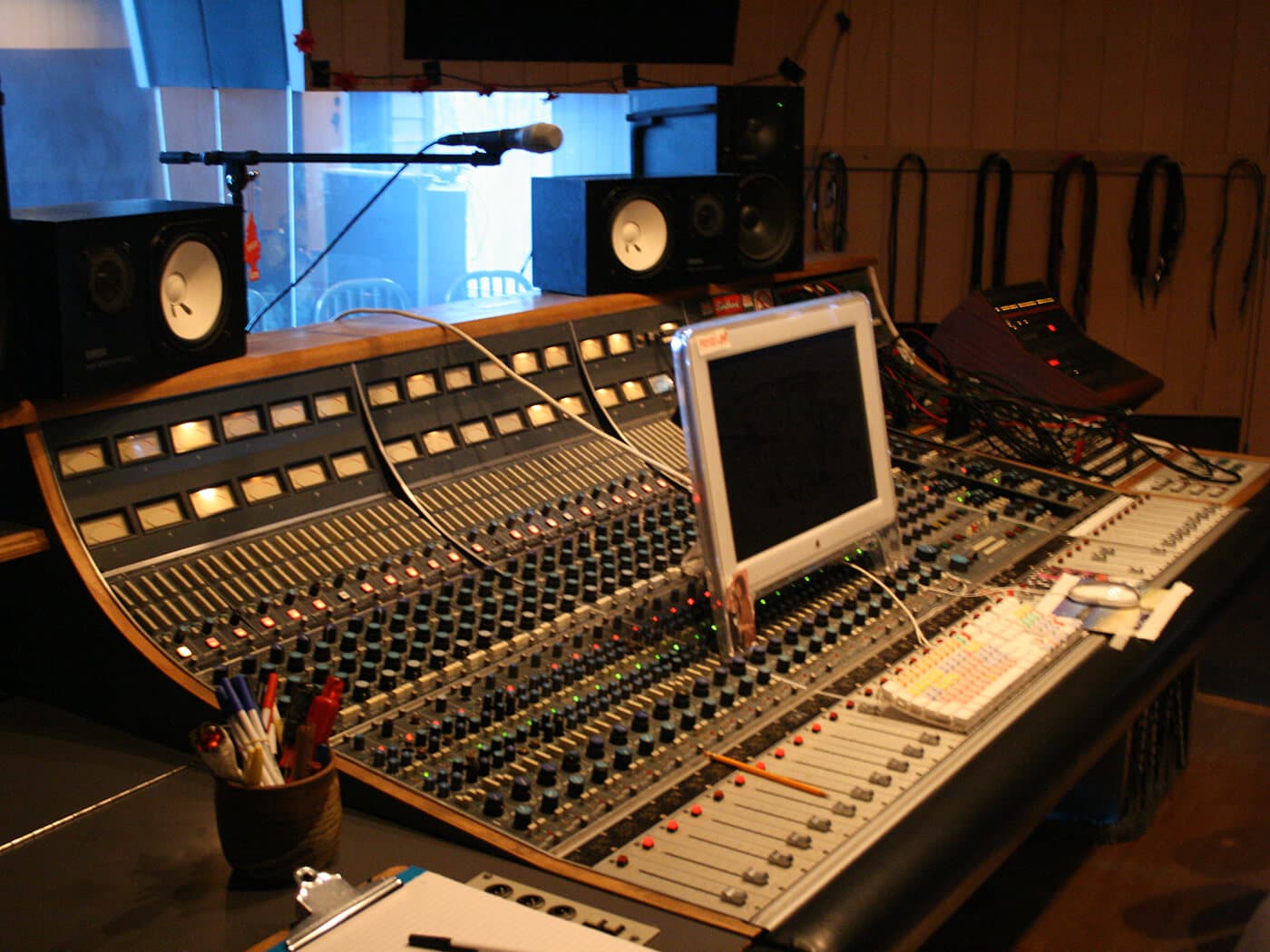
“Smells Like Teen Spirit”
Nirvana · 1991
Spoilers — show all 10 songs and the desks behind them
“Smells Like Teen Spirit” — Nirvana · 1991
Neve 8028 — Sound City Studios
The grungiest record of the decade ran through a $72,000 hand-wired Neve. Dave Grohl loved that desk so much he later bought the whole console and moved it into his own studio.
“Thriller” — Michael Jackson · 1982
Harrison 4032 — Westlake Studios
The best-selling album in history was tracked and mixed by Bruce Swedien on a Harrison — often in the dark, because Michael hated having the lights on while he sang.
“Nebraska” — Bruce Springsteen · 1982
TASCAM Portastudio 144
No studio. The Boss cut the entire album onto a cassette 4-track in his bedroom with two SM57s. The rough 'demo' was so haunting it became the actual record.
“Stairway to Heaven” — Led Zeppelin · 1971
Helios — Island's Basing Street Studio 2
The bulk of the most-played track in rock radio history was cut on a hand-built Helios desk. That very console later sold at auction for $142,424.
“Ziggy Stardust” — David Bowie · 1972
Trident A-Range — Trident Studios, London
Only thirteen A-Range consoles were ever built. Ziggy was among the first records mixed on one — the same desk lineage behind Queen and Elton John.
“Stayin' Alive” — Bee Gees · 1977
MCI — Criteria Studios, Studio C (Miami)
Four of the ten best-selling albums ever made ran through this one Criteria MCI desk — including Saturday Night Fever, Hotel California, and Rumours.
“Hysteria” — Def Leppard · 1987
SSL 4000 — with Mutt Lange
Mutt Lange tracked the vocals straight into the SSL's own preamps. That console's punchy, in-your-face compression basically is the sound of the 1980s.
“Don't Go Breaking My Heart” — Elton John · 1976
API — Sunset Sound, Los Angeles
Sunset Sound's custom API desk — the same room that shaped the Doors and the Rolling Stones — gave Elton's chart-topping duet its snap and punch.
“Is This It” — The Strokes · 2001
Soundcraft Ghost — a Lower East Side basement
The album that rebooted rock was cut on a budget Soundcraft Ghost in Gordon Raphael's basement studio. It was voted the #1 record of 2001 by nearly every critic alive.
“That Horn” — Joseph Thomas · SyncByJT · 2026
Mackie 8-Bus
The affordable desk that punched way above its price — a Mackie 8-Bus even ended up on parts of Alanis Morissette's Jagged Little Pill (engineers said it often sounded better than the pricey pres). It's also the board behind our own 'That Horn.' Hear it in the catalog.
AI Studio Guides
Mixing and mastering, genre by genre, for producers making music with Suno, Udio, and friends. Everyone's welcome — here's how to make it sound like a record.
Mixing & Mastering AI Pop
Pop runs on excess by design — stacked hooks, stacked synths, a chorus that has to feel bigger than the verse by any means necessary. AI generation gives you that excess for free and none of the judgment that usually keeps it in check. This one is about finding the record inside the pileup.
Read Genre guideAI Hip-Hop & Trap
The 808 decides everything else in a trap record before a single hi-hat is programmed. This guide walks through tuning it to the track, keeping it out of the kick's way, taming the roll, and finishing loud without flattening the low end that made the track worth finishing.
Read Genre guideAI R&B & Soul
R&B has never been a genre that shouts to be believed — it leans in and trusts you to lean in too. This guide moves slowly through the specific decisions that make an AI-generated soul vocal feel close rather than loud, untangles the low-mid crowd where Rhodes and bass are always fighting for the same few inches of frequency, and explains why the genre's dependence on dynamic range means a quieter, more honest master will now win on streaming rather than lose.
Read Genre guideAI EDM & House
Your AI EDM track sounds enormous in your headphones. Whether it survives a real sound system is a different question entirely — this is what changes between the two, and what to fix before it gets there.
Read Genre guideAI Lo-Fi & Chillhop
Lo-fi is one of the few genres where imperfection is the craft, which makes it one of the hardest for AI tools to fake convincingly. This guide is about the difference between degradation you chose and degradation that just happened to a file — and what it takes to close that gap before the track leaves your hands.
Read Genre guideAI Rock
AI rock tracks tend to fail in the same three places: guitars that phase-cancel instead of widen, a 400-800Hz box that makes everything sound like it's playing through a phone speaker, and a drum bus that's louder without being heavier. None of that gets fixed by turning things up.
Read Genre guideAI Country
Country is a lyric genre wearing an arrangement. Everything here — the guitar, the steel, the fiddle, the space you leave — gets judged by one question: can you hear the story. This guide walks through what that actually means at the mixing desk, and why AI-written country songs tend to fail it in the same three or four places.
Read Genre guideAI Ambient & Cinematic
Ambient and cinematic AI tracks tend to arrive wide but flat — every layer at the same distance. This guide is about building an actual sense of scale: pre-delay and decay time as distance controls, the low-mid horizon that forms when pads stack, why this genre's wide dynamic range is a real technical advantage under 2026 streaming loudness rules, and what Suno's rebuilt stem tools can and can't hand back once a track needs separating.
Read Genre guideAI Drill & UK
Drill runs on space and one moving low note. This guide covers the 808 slide as lead instrument, the 138-145 half-time pocket, hi-hat placement, sub translation on small speakers, narrow reverb, and mastering without crushing the gaps that make the genre work.
Read Genre guideAI Indie & Bedroom Pop
Indie and bedroom pop run on imperfection, which means the usual mixing advice — clean this up, brighten that, compress it flatter — is exactly wrong half the time. This is a guide to telling the charm apart from the actual problems, keeping a vocal present without making it slick, getting usable stems out of Suno's rebuilt split tools, and understanding what an analog character pass changes on a record that's supposed to sound like it was made in a room, not a facility.
Read Genre guideAI Hyperpop
Hyperpop is the genre that mixes with the distortion left in on purpose, which makes it the hardest one to give generic advice about — every decision is really a decision about where the chaos is allowed to live. This walks through one AI-generated hyperpop track in the order the problems actually showed up.
Read Genre guideAI Afrobeats
Afrobeats moves because its parts disagree with each other on purpose. This guide takes the groove apart layer by layer — kick placement, percussion vocabulary, low end, vocal space — before it ever gets to tone, and shows where AI generation tends to smooth over the exact friction that makes the record move.
Read Genre guideAI Metal
Where the low end actually sits, why more gain buys less clarity, and what loudness normalization has already decided about the brickwalled metal master — a frequency-by-frequency read on mixing AI-generated metal.
Read Genre guideAI Jazz & Nu-Jazz
Jazz was recorded, for most of its history, as a document of a room and a conversation happening inside it — which is exactly what an AI arrangement, built from separate generated objects, doesn't start with. This guide covers the dynamic-range vocabulary jazz depends on, why streaming loudness normalization is finally on the genre's side, what actually makes upright bass and ride cymbal read as physical instruments, and where an analog pass can help eight independently-born stems sound like they came from the same room.
Read Genre guideAI Singer-Songwriter & Acoustic
A voice and a guitar leave nowhere to hide. This guide is about the specific, small decisions a sparse arrangement forces — gentle compression that keeps a phrase's shape, the low-mid fight between guitar body and chest voice, room size as a way of describing closeness, and the sustain and phrasing that still separate a generated take from a lived-in one.
Read How-toHow to Label Your AI Music
Yes — in 2026 you should disclose AI when you distribute. The industry standard, DDEX, is granular: you flag AI element by element — vocals, lyrics, composition, mixing, mastering — not one blanket 'AI' stamp. Disclose honestly, and count every genuinely human step, like a real mix and master, as exactly that.
Read How-toHow to Master a Suno Track for Spotify
You finished a song in Suno and it sounds quiet or flat next to real releases on Spotify. Here's what mastering actually does about it.
Read How-toHow to Export Stems from Suno Pro (and What to Send)
Stems give a real engineer control that a single stereo file never can. Here's how to get them out of Suno Pro and what to hand over.
Read How-toWhy AI Music Sounds Flat — and How Analog Fixes It
If your AI track sounds flat, thin, or subtly 'off,' you're not imagining it. Here's the honest reason and the real fix.
Read How-toHow to Mix AI Vocals So They Sit Right
The vocal is where AI most often gives itself away — too distant, a little harsh, not quite human. That's fixable.
Read How-toUdio vs Suno: Getting the Cleanest Stems
Udio and Suno both make great starting points and both let you export stems on paid plans. Here's how to get the cleanest result from either.
Read The gearThe Mackie 8-Bus Console: Analog Glue for AI Tracks
The console is the constant — everything runs through the Mackie 8-Bus. It's the desk that fuses separate AI stems into one cohesive, weighty record.
Read The gearThe SSL Alpha 8: Clean, Precise Conversion for AI Music
The SSL Alpha 8 is the clean one — near-transparent conversion that keeps your track crisp and focused on its way out to analog.
Read The gearThe Apogee Rosetta 800: Tape-Warm Conversion for AI Tracks
The Apogee Rosetta 800 is the warm one — a slightly tape-like character that's the go-to for giving AI tracks vintage mood and body.
Read The gearThe RME ADI-2 FS: The Honest Final Word for AI Masters
The RME ADI-2 FS is the honest one — the reference-grade A/D that captures your analog master back to digital without coloring the truth.
Read The gearThe Eventide H9: Space, Movement, and Mood for AI Music
The Eventide H9 is the mood-and-motion box — legendary reverbs, pitch, and modulation that give flat AI tracks real space and atmosphere.
Read